Devulcanization 101: Understanding the Science Behind High-Value Rubber Recycling
Devulcanization of waste elastomers has become one of the most important topics in the field of advanced recycling and circular economy technologies. Recent scientific publications generally focus on thermal, mechanical, chemical, or hybrid approaches to rubber devulcanization.
A review of the Scopus database using the keyword “Devulcanization” reveals that research activity in this field has accelerated significantly over the past three years. However, a closer examination of these studies shows that many focus primarily on combinations of existing technologies or on end products with relatively low added value, such as asphalt modifiers, floor tiles, molded filler products, or generic filler materials.
The Critical Difference Between Devulcanization and Reclaiming
One of the main commercial challenges in the rubber recycling industry stems from the frequent confusion between the terms devulcanization and reclaiming.
In reality, technical details are crucial when recycling elastomeric waste. Producing high-performance recycled rubber requires selecting the correct technological pathway.
According to ASTM D6814, devulcanization is defined as the process of selectively breaking chemical crosslinks in cured rubber.
In contrast, ASTM D1566 defines reclaimed rubber as vulcanized rubber that has been thermally, mechanically, and/or chemically plasticized for use as a rubber diluent, extender, or processing aid.
Although these concepts are fundamentally different, both terms are often used interchangeably in scientific publications, patents, and industrial discussions.
Why Selective Bond Breaking Matters
Both devulcanization and reclaiming aim to improve interfacial interactions between rubber and other components within a compound, ultimately enhancing material performance.
However, the mechanisms behind these processes are significantly different.
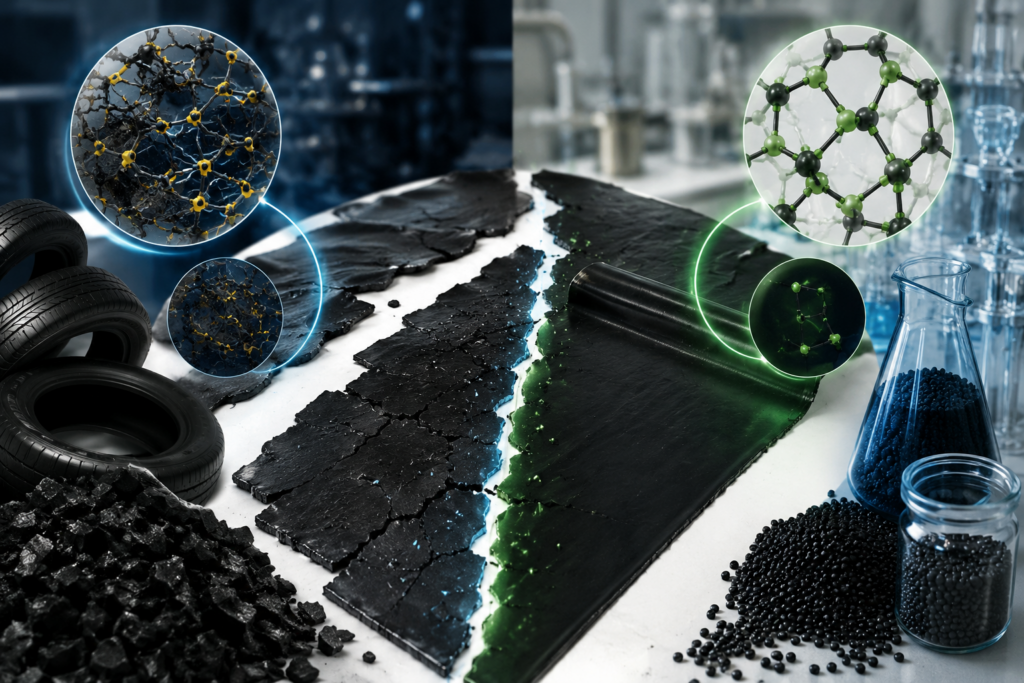
Devulcanization can be described as the selective cleavage of sulfur crosslinks within the three-dimensional rubber network while preserving the polymer backbone.
Reclaiming, on the other hand, typically involves a combination of random crosslink breakage and main-chain degradation, which often results in lower-performance materials.
From a theoretical perspective, selective devulcanization is possible because sulfur-containing bonds require less energy to break than carbon-carbon bonds:
C–C bond energy: approximately 348 kJ/mol
C–S bond energy: approximately 273 kJ/mol
S–S bond energy: approximately 227 kJ/mol
As a result, effective devulcanization technologies focus on breaking S–S and C–S bonds while maintaining the integrity of the polymer backbone.
The Complexity of Rubber Devulcanization
Producing technically successful devulcanized rubber requires careful optimization of numerous physical and chemical parameters.
The challenge becomes even greater because most rubber products contain complex formulations consisting of:
Natural and synthetic rubber polymers
Carbon black
Silica
Calcium carbonate
Kaolin
Process oils
Vulcanization chemicals
Performance additives
The interactions among these materials create highly complex structures that require advanced process control to achieve selective devulcanization.
The Future of Advanced Rubber Recycling
As sustainability targets become increasingly ambitious and demand for circular materials continues to grow, devulcanization technologies are expected to play a critical role in the future of the rubber industry.
The ability to selectively recover high-value elastomeric materials rather than downcycle waste into low-performance applications represents a major opportunity for achieving true circularity in rubber manufacturing.
Advanced devulcanization technologies have the potential to transform end-of-life rubber from a waste stream into a valuable secondary raw material, supporting both environmental sustainability and industrial competitiveness.